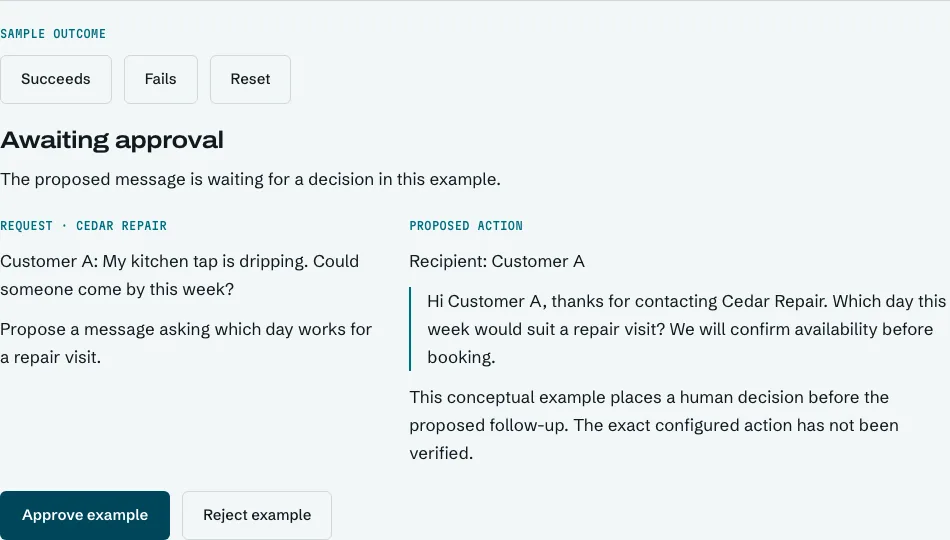
featured product
Vora
Implemented
An AI CRM platform for service businesses: missed-call text-back, lead follow-up, campaigns, and scheduling in one system. Approval requirements depend on the action and the configured policy.
Every row comes from a real business. Open one to see the fix I build for it.
You're with a client, three calls go unanswered. One was a $3K lead who booked with a competitor by lunch.
Voice agent answers instantly, books the appointment, routes emergencies, handles FAQs. 24/7.
Website forms pile up in your inbox. That hot lead from 8 AM? Still waiting at noon. They've moved on.
AI scores the lead, sends a personalized response, adds them to a nurture sequence. Automatically.
An hour a day on invoices, calendar updates, data entry. It's the work you hate most and it never ends.
Invoices auto-generate from completed work. Calendar syncs from the booking agent. Data entry eliminated.
You know you should post, send that newsletter, update the website. But you're too exhausted by 5 PM.
AI posts to social, sends email/SMS campaigns, writes blog posts, handles SEO. You review over coffee.
You need a receptionist, a marketing person, someone to chase invoices. But payroll for three people isn't realistic.
Virtual staff for front desk, social media, collections, customer service. They work 24/7 and never call in sick.
Urgent requests buried under spam. Client questions unanswered. You spend 45 minutes just sorting.
AI categorizes, auto-replies to common questions, flags what actually needs you. 3 items, not 47.
Intake forms, contracts, and PDFs sit in a queue. Someone has to read each one, pull the fields, and file it. That someone is expensive and slow.
An agent reads each document, extracts the fields, and files it to the right record. A person reviews the exceptions, not the whole stack.
Every new client means the same emails, the same forms, the same chasing for missing information. It stalls the work and it looks unpolished.
The system collects intake, checks it for gaps, chases what is missing, and sets up the account, so the first real conversation is about the work.
A client asks a question and the answer is in a file from two years ago that nobody can find. So it gets re-answered from scratch, sometimes wrong.
A knowledge assistant searches your documents and answers with the source attached, so the team stops re-deriving what the firm already knew.
Most AI projects fail because they automate a process nobody understood. Mine start with lean process mapping, so the AI lands where it pays. I call the method Charted: map the work, gate the risky parts, and keep checking the output after it ships.
Short interviews with you and the people who actually do the work. Where does the time really go?
One working session. Your core process goes up on the wall: every step, handoff, and workaround.
Every automation idea gets scored on payoff, feasibility, data, and risk. Only the honest ones survive.
I build the winner with one success metric and guardrails attached: anything risky waits for your approval before it runs. We agree up front what scale, fix, or stop looks like.
Your team gets trained, the runbook gets written, and the system becomes yours to keep.
I keep checking the work. Every month I sample what the AI produced, score it against the standard we set, and send a one-page report. Drift gets caught before you feel it.
Phases 1 to 3 are the audit. Phase 4 is the build sprint. Phase 5 closes either one. Phase 6 is the retainer, and it's optional: the system is yours either way.
Four kinds of systems, built from the same working parts.
Answer every call, book the job, route the emergency.
Answer from your own records instead of a generic guess.
Invoices, scheduling, and data entry that run themselves.
Email and SMS that go out on schedule while you work.
Fixed scope, plain deliverables, and nothing gets built before the audit says it's worth building. Every engagement is a fixed fee, quoted before we start. No hourly billing, no surprise scope. If the scope changes once we're underway, that gets re-quoted and agreed before work continues.
Two to three weeks inside your business. I interview your team, map how the work really moves, and score where AI genuinely pays off (and where it doesn't).
Audits start at $750, fixed scope. You have the number before the call, and build pricing comes from what the map finds.
The top item on your roadmap, built and wired into your real systems. An automation, a website that converts, search visibility, or follow-up marketing. One success metric, your team trained on it.
4-8 wksI stay on to check the work. Every month I sample what the AI produced, score it against the standard we set in the pilot, and send you a one-page report. Drift gets caught before you feel it, and you still get tuning and one new automation a month. Capacity is capped at a few clients at a time.
monthlywhat the audit produces
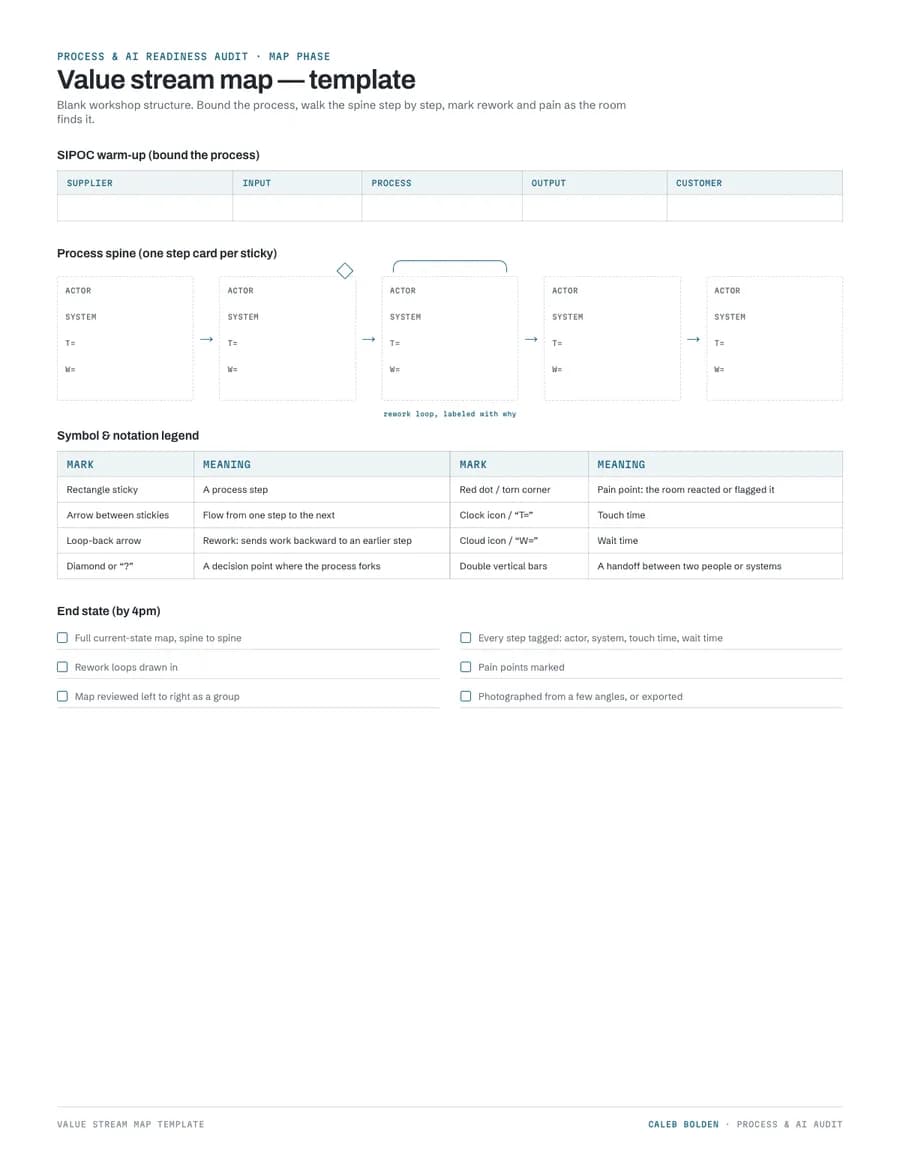
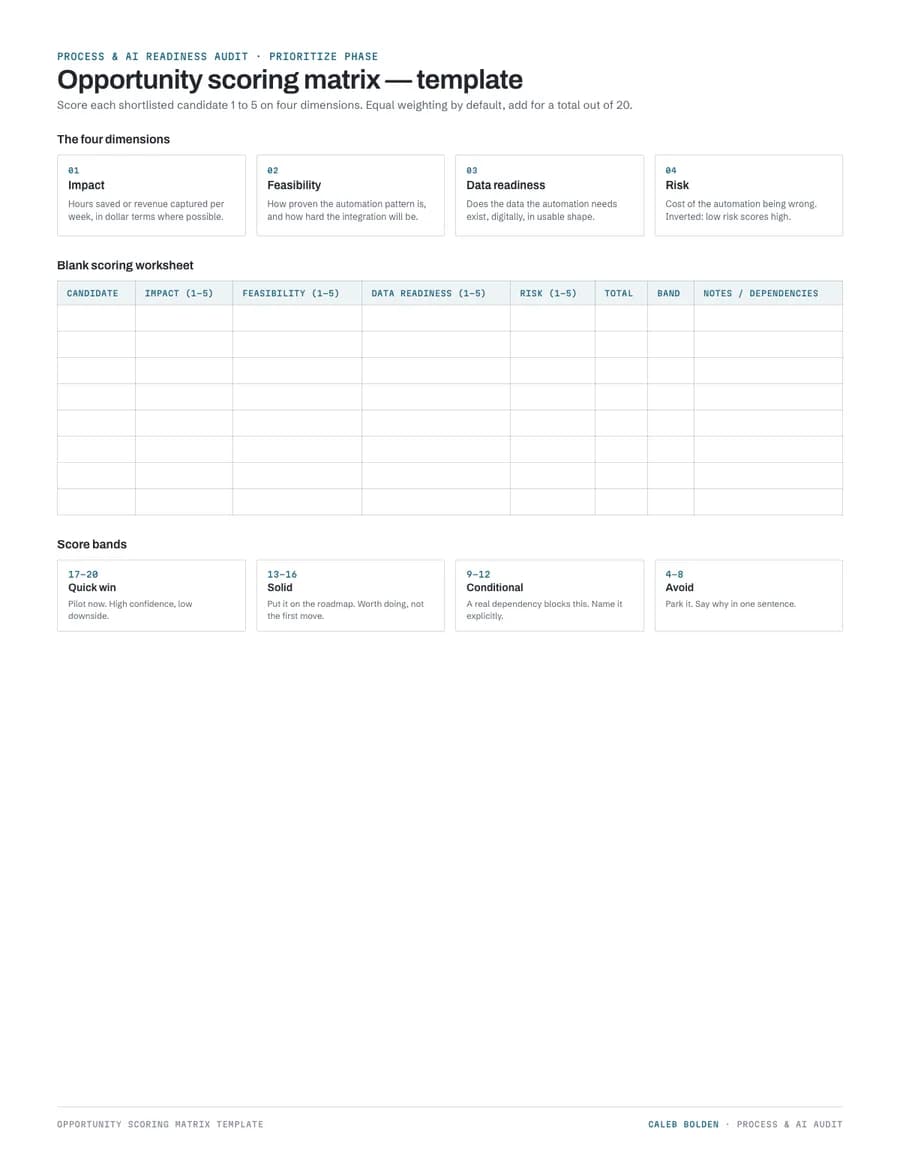
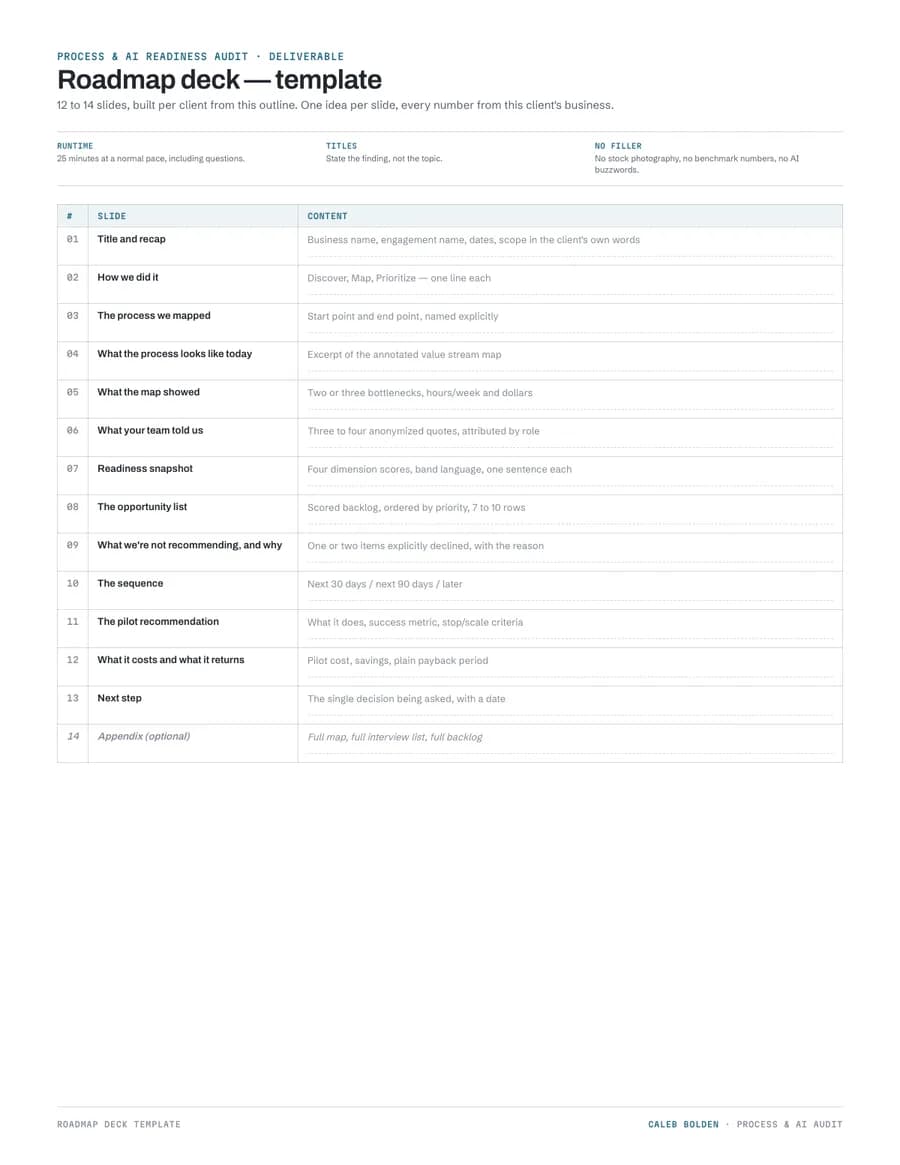
The three templates your audit fills in. You keep all of them, whether or not I build anything.
The sprint and the retainer build on what the audit finds. That order is the point.
I'm a builder first. This work ranges from products I run day to day to prototypes and developer previews whose limits are stated beside the example.
featured product
Implemented
An AI CRM platform for service businesses: missed-call text-back, lead follow-up, campaigns, and scheduling in one system. Approval requirements depend on the action and the configured policy.
developer tools
Developer preview
A developer preview for bounded local agent execution, with an inspectable event trace, a contract-derived terminal run record, and fixed limits clearly separated from measured usage.
Implemented
A software agent workflow for planning, implementation, and review. Its example separates a successful run, a retry, and a blocked result, with the default automatic merge policy stated beside the steps.
Implemented
A shared configuration workflow that turns authored fragments into instructions for different coding tools. The example compares generated outputs and shows what becomes stale when a source fragment changes.
Prototype
An operations dashboard combining unattended runs, pending decisions, sample spend, and deployment records. This prototype example shows how an operator can find work that needs attention without implying verified deployment.
more products and tools
live
A management platform for clubs and nonprofits: members, dues, events, and an AI assistant that answers from the org’s own records.
live
The chat agent running live in the corner of this site, answering questions from my own content.
live
Tooling I publish on GitHub.
in development
An AI operating system for real estate agents: a team of agents handling follow-up, listings, and paperwork over web and SMS.
The chat assistant on this site is one of these systems. Open it and ask what AI could take off your plate.
Small businesses of every kind. Service businesses that run on calls, crews, and schedules. Office and professional firms that run on clients, documents, and billing. Any business where the owner does work a system should.
Tell the assistant about your business and get a plain-language breakdown of what's possible. It's a system I built, working right there in the corner.
Rather talk to me directly? Let's talk · or take the free AI readiness assessment
the method: map it, score it, then automate what pays